
Umrah is an act of worship involving Ihram, Tawaf of the Ka'bah, Sa'i between Safa and Marwah, and completion by shaving or shortening the hair.
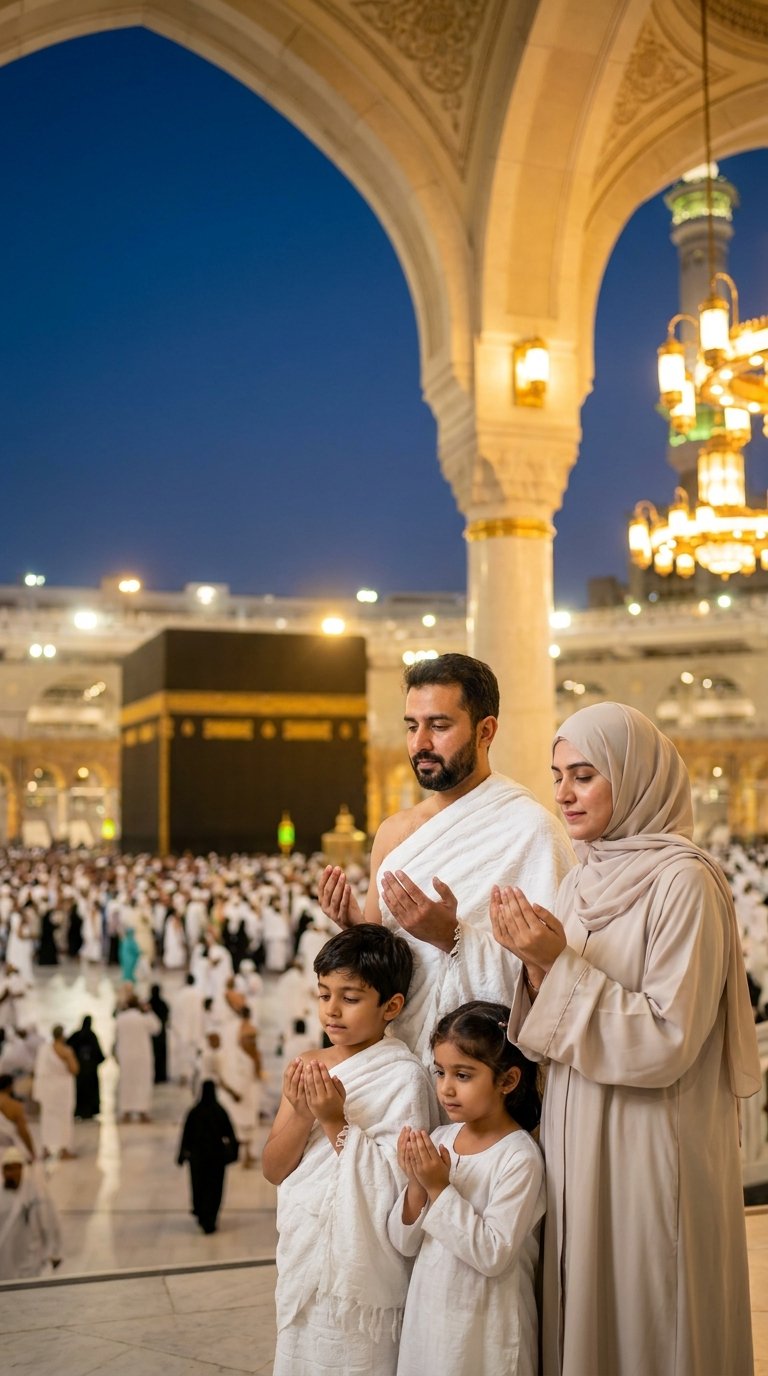
This guide is built around Qur'anic evidence and authentic Prophetic narrations, especially reports in Sahih al-Bukhari and Sahih Muslim. Where scholars differ on a detailed fiqh issue, this guide does not present one view as the only valid view.
A dua is not labelled a Sunnah practice unless there is reliable evidence for it — in particular, there is no authentic requirement for a different fixed dua for each Tawaf or Sa'i round.
This is an educational guide, not a substitute for a qualified scholar's advice in an individual case such as missed obligations, Ihram violations, illness, menstruation-related questions, disability, or uncertainty about a vow/fidyah.
A Miqat is a boundary appointed by the Prophet ﷺ for people intending Hajj or Umrah. A person intending Umrah should not knowingly pass the relevant Miqat without entering Ihram.
The Prophet ﷺ designated Dhul-Hulayfah for Madinah, al-Juhfah for Sham, Qarn al-Manazil for Najd and Yalamlam for Yemen; the ruling also applies to those who pass through these points intending Hajj or Umrah. (Source: Sahih al-Bukhari 1526, 1530)
For travellers arriving by air, the exact point at which their flight crosses the Miqat depends on the route — do not assume that every flight from Pakistan has the same crossing point. Be ready for Ihram before the aircraft crosses the relevant boundary, and follow your qualified guide/airline instructions.
Men wear the Ihram garments (Izar and Rida). The detailed prohibited clothing items are established in authentic hadith. (Source: Sahih Muslim 1177b and related narrations)
Women do not have a special two-piece Ihram uniform — a woman enters Ihram in permissible modest clothing. Detailed rulings concerning face covering, gloves and other matters should be checked with a qualified scholar according to her circumstances.
The essential niyyah is the intention in the heart. A pilgrim may verbally state the intention, but no particular wording should be treated as an obligatory formula.
Recite this often from the moment you enter Ihram:
Enter with humility and remember that the purpose of the journey is worship. Avoid pushing, harming others, or becoming distracted by unnecessary photography and conversation. The general etiquette of entering a mosque applies — do not invent a special Umrah dua where no authentic evidence exists.
Tawaf consists of seven circuits around the Ka'bah, beginning at the area of the Black Stone (Hajar al-Aswad) and keeping the Ka'bah on the left. If reaching or kissing the Black Stone is not safely possible, do not push or harm people — simply gesture toward it and say Allahu Akbar.
In the Tawaf connected with Umrah, men perform brisk walking (ramal) in the first three circuits and normal walking in the remaining four, where this Sunnah applies. Women do not perform ramal. (Source: Sahih Muslim 1218a and related narrations)
There is no authentic fixed dua assigned to each of the seven circuits. A pilgrim may make personal dua, dhikr and Qur'an recitation.
After seven circuits, pray two rak'ahs. If practical, pray behind Maqam Ibrahim; if crowded, pray elsewhere in the mosque without obstructing people.
Drink Zamzam and make sincere dua to Allah. The famous long formula sometimes circulated online should not automatically be presented as a Prophetic fixed dua without evidence.
A sound narration states that Zamzam is for the purpose for which it is drunk; this narration is recorded by Ibn Majah and graded Hasan on Sunnah.com. (Source: Sunan Ibn Majah 3062)
Begin at Safa and finish the seventh circuit at Marwah.
Counting: Safa→Marwah (1), Marwah→Safa (2), Safa→Marwah (3), Marwah→Safa (4), Safa→Marwah (5), Marwah→Safa (6), Safa→Marwah (7).
Men may move briskly between the designated green markers where this is safely possible. Women walk normally. Do not run in a way that harms or obstructs others. (Source: Sahih Muslim 1218a)
After completing Sa'i, men shave (Halq) or shorten (Qasr) the hair. Shaving has a particular virtue in authentic hadith, while shortening is also permissible. (Source: Sahih Muslim 1304)
Women do not shave their heads — they shorten their hair according to the applicable fiqh ruling. Because scholars differ on details of amount and method, women should follow a qualified scholar/guide for their circumstances.
After the hair is shaved or shortened, the Umrah is complete and the restrictions of Ihram end for that Umrah.
Umrah Mubarak! 🕋 May Allah accept your Umrah.
This guide is intended for educational and practical assistance. KAAF Travel & Tours does not present itself as issuing religious fatwas. For a pilgrim's specific fiqh question — especially concerning missed obligations, Ihram violations, women's personal circumstances, illness, disability or fidyah — please consult a qualified scholar.
Travel arrangements, visa rules, hotel policies, transport arrangements and Saudi operational requirements can change. Pilgrims should verify current travel requirements separately before departure.